How Strata Councils Should Schedule Building-Wide Fireplace Servicing
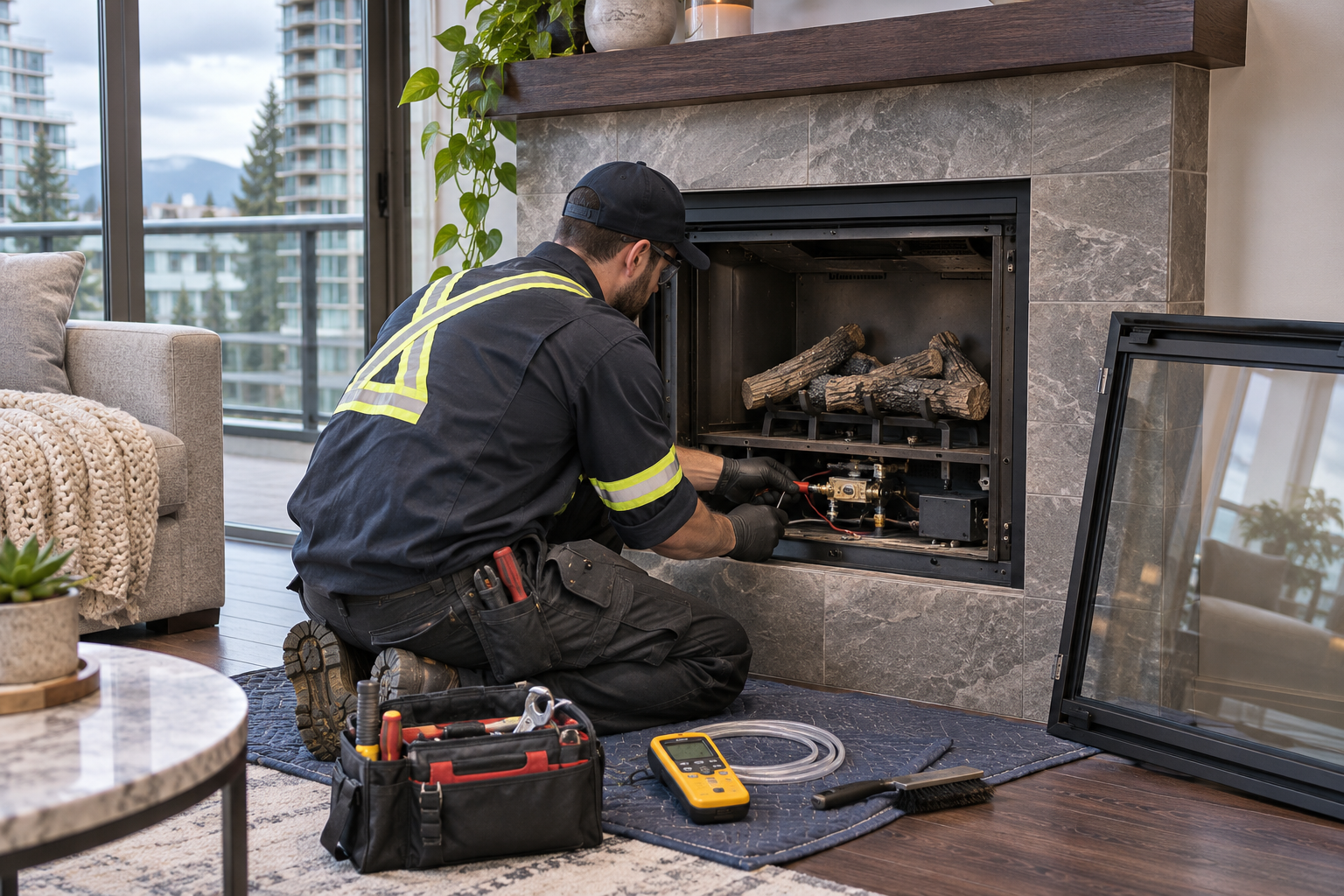
The simplest way for a strata council to schedule building-wide fireplace servicing is to book one licensed gas contractor for a set block of days each year, ideally before the heating season, give every suite written notice that meets your entry bylaw, group appointments by floor or building, and track every unit until each one is either serviced or formally followed up. Technical Safety BC recommends having all home heating appliances serviced annually to prevent fires and carbon monoxide poisoning, and says gas appliance servicing should be done by a certified gas fitter employed by a licensed gas contractor. A building-wide program makes that easier to deliver and to prove.
If your building hasn't done this year's round yet, it's not too late to book it now. Here's how to plan it.
Why do it building-wide?
- Consistency. Every unit gets the same checklist from the same contractor.
- Records. The council ends up with one report covering the whole building.
- Shared venting. In many buildings, vents and terminations run through or onto common property, so a problem in one unit can matter to others.
- Leverage. One booking for many units is usually easier to coordinate than dozens of individual appointments.
Who pays and who's responsible for each fireplace depends on your strata plan and bylaws. Settle that before you book, and say it plainly in your notice to owners.
Step 1: Decide the timing
Technical Safety BC's guidance is annual service. Most councils aim for late summer or early fall, so problems are fixed before the first cold snap and contractors are less busy than in peak season. Pick a window and keep it the same each year so owners learn to expect it.
Step 2: Choose and brief the contractor
Ask for:
- Proof the company is a licensed gas contractor, and that the technicians are certified gas fitters. Technical Safety BC says qualified gas fitters should show their certification card when asked.
- Their per-unit checklist, and how they'll report findings.
- A plan for units that need parts or follow-up visits.
- Insurance and WorkSafeBC clearance.
Technical Safety BC's own servicing checklist for gas fireplaces is a good baseline. It includes cleaning the glass and unit to the manufacturer's guidelines, checking the vent system and termination, inspecting relief flappers and door gaskets, inspecting the burner, venturi, air openings, gas valve and pilot system, checking log placement against the manual, and verifying fans, thermostats, remotes and safeties work.
Step 3: Give proper notice
Under the Standard Bylaws, bylaw 7 requires owners, tenants, occupants and visitors to allow a person authorized by the strata corporation to enter a strata lot at a reasonable time, on 48 hours' written notice, to inspect, repair or maintain property the strata is responsible for. The notice must include the date, the approximate time of entry and the reason. Your strata may have amended this bylaw, so check the filed version.
Notice details matter. In one Civil Resolution Tribunal decision, a strata's letter delivered slightly less than 48 full hours before entry was found not to meet the bylaw. Build in a margin.
Good practice:
- Post and deliver notices well ahead, not just 48 hours before.
- Include a sign-up or preferred-time option where possible.
- Send copies to landlords and ask them to inform tenants. The BC government notes that under the Standard Bylaws, tenants must also permit entry with 48 hours' written notice.
Step 4: Organize the service days
| Task | Who | Timing |
|---|---|---|
| Confirm contractor dates and crew size | Council or property manager | Several weeks ahead |
| Deliver written notices with date, time window and reason | Property manager | Well before the 48-hour minimum |
| Collect owner availability and access instructions | Property manager | Before service days |
| Group units by floor, stack or building | Contractor and manager | Before service days |
| Arrange key access or escort for absent owners, if bylaws allow | Property manager | Before service days |
| Service days | Contractor | Scheduled block |
| Collect per-unit reports | Property manager | Daily during service |
| Book follow-ups for missed or failed units | Property manager | Within days |
Step 5: Handle missed units and problems
Some suites won't be accessible on the day. Track them, reschedule quickly, and record every attempt. If a technician finds a unit that isn't safe to operate, the owner and council need to know right away. Technical Safety BC lists signs that service is needed immediately, including pilot outages, a yellow or wavering burner flame, gas odour, booming on start-up and condensation inside windows.
Step 6: Keep the records
Ask the contractor for a unit-by-unit summary: serviced, deficiencies found, parts needed, follow-ups booked. Keep it with your other maintenance records. A consistent annual record helps when planning replacements, answering buyer questions and dealing with insurers.
Communicating with residents
Keep the notice short and clear:
- What's happening and why (safety and annual servicing).
- The date, approximate time and that entry is authorized under the bylaws.
- What residents need to do: clear the area in front of the fireplace, turn the unit off a few hours ahead so it's cool, secure pets.
- Who to contact to change a time.
- A reminder to check that their carbon monoxide alarm works; Technical Safety BC recommends a certified CO detector for added protection.
Owners curious about what a single-unit service involves can read the homeowner guides at Kongtractors.
The bottom line
Pick a fixed annual window, hire a licensed gas contractor with a clear checklist, give notice that comfortably meets your entry bylaw, run the service days by floor, chase every missed unit, and keep a single record for the building. Done the same way each year, it becomes routine for council and residents alike.
Frequently asked questions
How often should fireplaces in a strata building be serviced?
Technical Safety BC recommends annual servicing of home heating appliances, including gas fireplaces, to prevent fires and carbon monoxide poisoning.
How much notice does a strata need to give to enter a unit for fireplace servicing?
Under the Standard Bylaws, the strata must give 48 hours' written notice including the date, approximate time and reason for entry, unless it's an emergency. Check whether your strata has amended this bylaw.
Who can service gas fireplaces in a BC strata?
Technical Safety BC says servicing should be done by a certified gas fitter employed by a licensed gas contractor. Fitters should be able to show their certification card.
What should a strata do about units that miss fireplace servicing day?
Track every missed unit, reschedule quickly, and record each attempt. If a unit is found unsafe, notify the owner and council right away.